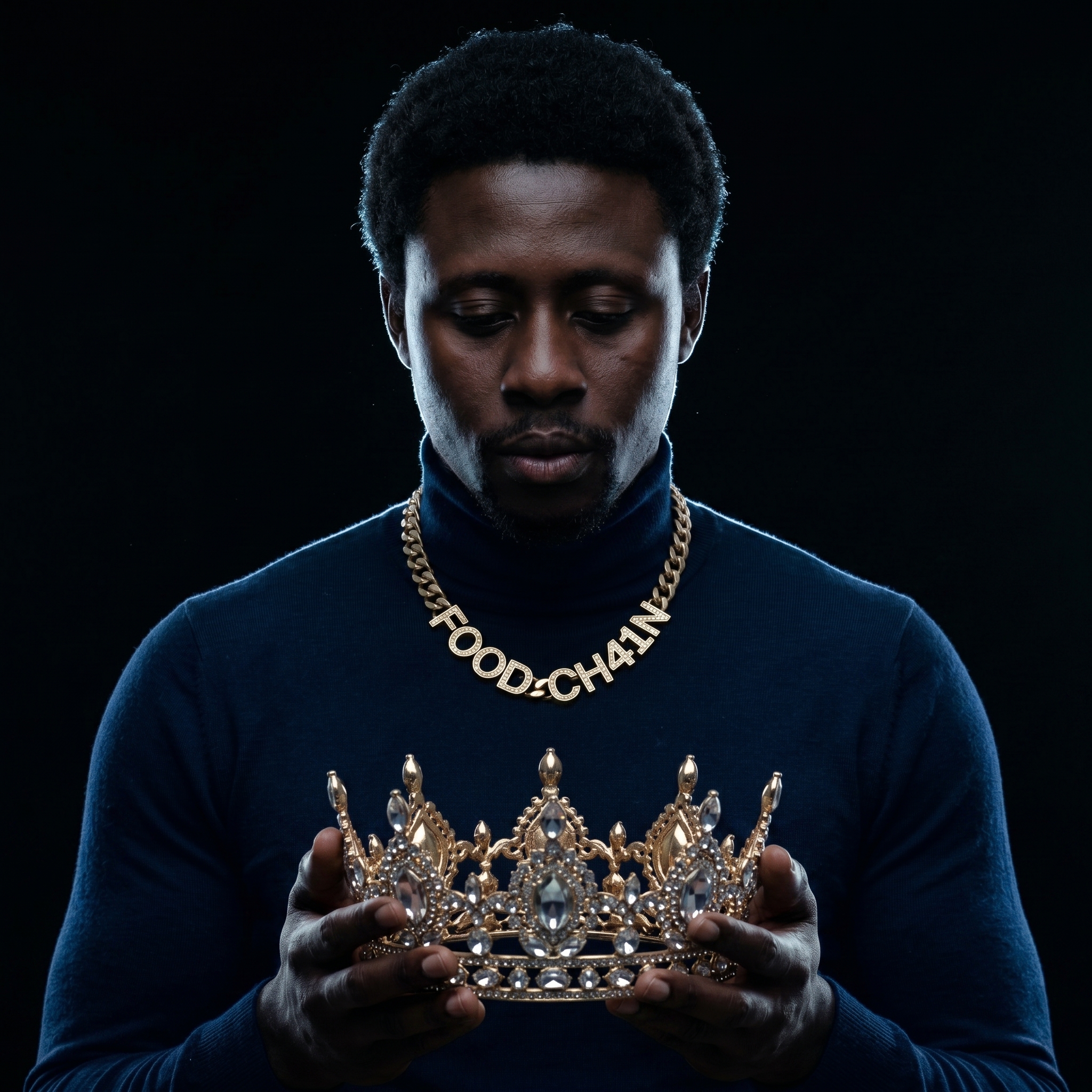
I'm an independent artist making music at midnight on Edifier speakers while my kids are asleep. I have a full-time job, a wife, and an album in progress called Food Chain. I've been making music since 2005. I know, broadly, that the streaming economics are bad. But I'd never actually sat down and read the data properly — the IFPI reports, the Spotify Loud & Clear numbers, the AI research — until this month.
I wish I could tell you it was reassuring. It wasn't. But I can tell you it was clarifying — and clarity, even when it's uncomfortable, is more useful than false hope.
Here's what the data actually says. No industry spin. No "but streaming is growing!" without context. Just the numbers and what they mean if you're an artist trying to build something real.
The $29.6 billion that most artists never see
The music industry made $29.6B in recorded music revenue in 2024. That sounds healthy. And at the industry level, it is — it's a return to pre-2000 levels after fifteen years of collapse. But that number is doing a lot of work hiding what's underneath it.
The three major labels — Universal, Sony, Warner — control roughly 70% of recorded music revenue. Streaming platforms take their cut before any money reaches rights holders. Distributors take theirs. Managers, lawyers, producers — each with a percentage. By the time money reaches an independent artist with no label, on a good distributor deal, you're seeing maybe 80-85 cents of every dollar your music generates on streaming. On a major label deal, you might see 20 cents — and only after you've recouped your advance.
What that chart doesn't show: the total music economy including live performance, publishing, sync, merch, and brand deals is closer to $70-80B annually. The IFPI $29.6B is just recorded music. The parts they don't track are bigger than the parts they do.
The streaming math nobody explains clearly
Here's the number that hit me hardest: you need 3.77 million Spotify streams per year just to earn US federal minimum wage. Before any splits. Before your distributor takes their cut. Before taxes. Just to match what someone earns flipping burgers.
These are gross rates to all rights holders — label, publisher, distributor, artist. On a major label deal where the artist sees 20%, a $4.00/1K Spotify rate becomes $0.80/1K to the artist. On a fully independent deal via DistroKid, you keep roughly $3.30-3.50/1K. The difference between being signed and being independent can be 4x on the same stream.
Streaming is a distribution channel. It is not an income. The sooner an independent artist internalises that difference, the sooner they start building a business instead of chasing a metric.
How the industry collapsed — and why it matters now
Understanding how the industry lost $24B between 1999 and 2014 matters because the same forces — format disruption, attention competition, platform consolidation — are happening again with AI. This time faster.
The AI question — and the honest answer
This is the part that gets complicated. AI-generated music is not a distant threat. In China, 56.9% of new songs uploaded in Q1 2025 were AI-generated. Suno — one of many AI music tools — crossed $200M ARR in 2025 and signed a licensing deal with Warner Music Group.
The argument you'll hear is that AI can't replicate human soul. I'm not convinced that argument holds. Consumers didn't maintain a "soul premium" for live over recorded in 1900. Or for analogue over digital in the 90s. The format always wins eventually if it's cheap enough and good enough.
AI is splitting the music market in two. The commodity tier — background music, generic production, stock beds — is being disrupted and will largely disappear as human income. The premium tier — culturally resonant, artist-branded, provenance-certified music with a real human story behind it — is actually becoming more valuable as AI floods the market with generic content. The question is which tier you're building toward.
What the data says you should actually do
I'm an independent artist, not an industry consultant. But after going deep on this data, here's what I think it means practically for anyone trying to build something real in music right now.
Three things consistently survive format disruption in music: owned audience (the only one that compounds and can't be taken away by algorithm changes), cultural specificity (the more distinctively yours your sound is, the harder it is to displace generically), and live presence (the one thing that genuinely cannot be replicated at scale). The artists who built around these things survived the CD collapse, the download era, and the streaming shift. The pattern holds.
The final verdict — honest answers to hard questions
| Question | Honest Answer | Confidence |
|---|---|---|
| Should musicians quit? | No — but only if they build like a business, not a hobbyist hoping for discovery. | Strong |
| Is streaming a viable primary income? | For 0.6% of artists. For everyone else: it is a distribution channel, not an income stream. | Strong |
| Will live performance survive AI? | Yes — but because of community and physical presence, not because AI "lacks soul." | Medium |
| Will AI replace human music? | In the commodity tier, largely yes. In the premium, culturally-specific tier, no — and that tier becomes more valuable as AI floods the market. | Medium |
| Do email lists actually matter? | More than any other marketing channel for independent artists at every stage. The ROI on owned audiences compounds forever. | Strong |
| Is running paid ads a valid strategy? | Yes — if you're measuring the right things. Cost per subscriber, not cost per stream. Owned audience, not rented reach. | Strong |
| Will Chinese AI models dominate music? | Technically, probably yes. Tencent's SongGeneration 2 is already beating Western tools on benchmarks and runs open-source. Geopolitics may slow adoption in Western markets — but won't stop it. | Watch closely |
I started this research expecting to find reasons to be discouraged. What I found instead was clarity about what actually works and what doesn't. The artists who understand the economics, build owned audiences, and create music that is specifically and irreplaceably theirs — those artists have a real business. Everything else is hope dressed up as strategy.
I'm building the first kind. Food Chain is the music. Fyn Nation is the audience. The data just confirmed I'm working on the right things.
The owned audience I'm building. First access to unreleased music, the Food Chain album before it drops, and direct transmissions from the studio.